Thursday, February 18, 2016

Birth Dates of Notable Kentuckians: February 18, 1914 - Pee Wee King

 Image from songwritershalloffame.org

From The Kentucky Encyclopedia -
Songwriter and musician Pee Wee King, the son of John and Helen (Mielczarek) Kuczynski, was born in Milwaukee, Wisconsin, on February 18, 1914. He joined the " Badger State Barn Dance" on Milwaukee's WJRN radio in 1933. The next year he was discovered by J.L. Frank and went to Louisville with a group called the Log Cabin Boys. In 1936 he went to WNOX in Knoxville and in 1937 to Nashville and the " Grand Ole Opry," where he stayed ten years. In 1942 he and his Golden West Cowboys were featured on the " Camel Caravan," which presented 175 shows in sixty-eight service-related establishments. In 1947 he returned to Louisville to appear on WAVE and other radio/television stations. He appeared in dozens of movies. The song Tennessee Waltz, which King wrote in collaboration with Redd Stewart, is country music's most- recorded (500 times), most-sold (70 million records) song of all time. Patti Page's version was one of the biggest hits in modern popular music history. King is a member of the Country Music Hall of Fame and the Nashville Songwriters Association Hall of Fame. In 1936 he married Lydia Frank.

CHARLES F. FABER, Entry Author

Selected Sources from UK Libraries:

Hall, Wade, and University Press of Kentucky. Hell-bent for Music : The Life of Pee Wee King. Lexington, KY: U of Kentucky, 1996. Web.
ML422 .K57 H35 1996, Fine Arts Library

Flatt, Lester., Earl. Scruggs, Pee Wee King, Redd. Stewart, Jimmy. Simpson, Jimmie Skinner, Joe Lulu Belle & Scotty., Rose Lee. Maphis, Hylo. Brown, Leon. Hobson, Lyle. Collins, Maphis, Joe, and Willis Brothers. Doin' My Time. Madison, Tenn.]: Starday, 1964.
LP7340, Fine Arts - Media Center

Sunday, February 14, 2016

Birth Dates of Notable Kentuckians: February 14, 1947 - Edward Norton Hamilton


 Image from www.courier-journal.com

Ed Hamilton, who was born in Ohio and grew up in Louisville, KY, has created a number of sculptures throughout the United States, including the Booker T. Washington Memorial at Hampton University, the Amistad Memorial in New Haven, Connecticut, and the Spirit of Freedom: African American Civil War Memorial in Washington D.C. A nationally recognized sculptor, he is the author of The Birth of an Artist: a journey of discovery. Hamilton, a graduate of Shawnee High School in Louisville, 1965, and the Louisville School of Art, 1969. He also attended the University of Louisville and Spalding College [now Spalding University]. He has received Honorary Doctor of Arts degrees from Western Kentucky University and the University of Louisville. For more see the Edward Hamilton website; and the Ed Hamilton interview [#209], "Connections with Renee Shaw," 02/03/2007, at KET (Kentucky Educational Television).

See photo image of Ed Hamilton at Great Black Kentuckians, a Kentucky Commission on Human Rights website.
Subjects:
Artists, Fine Arts, Authors, Sculptors

Geographic Region: Ohio / Louisville, Jefferson County, Kentucky

Selected Sources from UK Libraries:

Hamilton, Ed. The Birth of an Artist : A Journey of Discovery. Louisville, Ky.: Chicago Spectrum, 2006. Print.
NB237.H239 A2 2006, Fine Arts Library

Robson, Julien., and J.B. Speed Art Museum. Ed Hamilton, from the Other Side. Louisville, Ky.: Speed Art Museum, 2002. Print.NB212 .R63 2002, Fine Arts Library

Tuesday, February 9, 2016

Birth Dates of Notable Kentuckians: February 9, 1849 - Laura Clay

LAURA CLAY
Image from National Women's History Museum

From The Kentucky Encyclopedia -
One of the controversial figures in the national women's rights movement, Laura Clay was born at White Hall, her family's estate near Richmond, Kentucky, on February 9, 1849. Her parents were Cassius M. Clay , the noted antislavery activist, and Mary Jane (Warfield) Clay, both of prominent Bluegrass families. Laura Clay was educated at Lexington's Sayre School, where she graduated in 1865. She then spent a year at Miss Hoffman's finishing school in New York City and later studied at the universities of Michigan and Kentucky for short periods. She supported herself and financed her long public career with her income as a "practical farmer," managing a three-hundred-acre farm in Madison County, which she leased from her father in 1873 and owned after his death in 1903.

Clay's commitment to women's rights arose from her parents' bitter separation in 1869 and divorce in 1878, when she became aware that the property and legal rights of Kentucky women, especially those married, were woefully unprotected. After considering careers in teaching, law, and the missionary field, Clay decided to devote her life to the woman's movement. In 1888 she took the leading role in organizing the Kentucky Equal Rights Association (KERA) , which she served as president until 1912. Although the growth of the association was slow, its lobbying in Frankfort by the mid-1890s had won a number of legislative and educational victories, including protection of married women's property and wages, a requirement for women physicians in state female insane asylums, and the admission of women to a number of male colleges.

 As an officer in both the Women's Christian Temperance Union and the Kentucky Federation of Women's Clubs , Clay persuaded the groups to join the KERA in advocating additional benefits for women and children at the turn of the century. Their efforts secured legislation that provided for a women's dormitory at the University of Kentucky , established juvenile courts and detention homes, and raised the age of consent from twelve to sixteen years. Clay and other women activists saw the vote as the capstone of their movement. With the state legislature's grant of school suffrage in 1912, they won a partial victory.

 During the 1890s, Clay became the best-known southern suffragist and the South's leading voice in the councils of the National American Woman Suffrage Association (NAWSA). Her efforts were largely responsible for the establishment of suffrage societies in nine of the former Confederate states. Clay addressed constitutional conventions in Mississippi and Louisiana and managed an unsuccessful NAWSA effort to add women's suffrage to the South Carolina constitution of 1895. In 1896 Clay was elected auditor of the NAWSA, a post she held for fifteen years. She maintained a position of moderation and conciliation on the NAWSA official board in matters of both race and personality clashes. As an unpaid NAWSA field worker, she also directed suffrage campaigns in Oregon, Oklahoma, and Arizona. While chair of the association's membership committee, she introduced recruiting innovations that almost tripled the number of members, from 17,000 in 1905 to 45,501 in 1907. In 1911 Clay lost her bid for reelection as auditor, following a dispute between the southern and western suffragists and those from the East over administrative and organizational matters. Contrary to some accounts, neither the race question nor the issue of the federal amendment versus the state route to enfranchisement figured in this dispute. Despite her removal from the official board of the NAWSA, Clay for a number of years chaired association committees, contributed to fund drives, and worked in state suffrage campaigns.

In 1916 Clay was elected vice-president-at-large of a new organization, the Southern States Woman Suffrage Association, founded to win the vote through state enactment. Clay saw this organization as an auxiliary, not a rival, of the NAWSA, whose activities she continued to support. It was not until 1919, when the U.S. Congress enacted the Nineteenth Amendment, that Clay withdrew from the NAWSA, turned her energies to securing a state suffrage bill in Kentucky, and began openly to oppose the federal bill. She based her opposition to it on states' rights, asserting that the Nineteenth Amendment was a vast and unneeded extension of federal power. A product of her time, Clay was a believer in Anglo-Saxon superiority but was paternalistic, rather than Negrophobic, in her attitudes.

 After the ratification of the suffrage amendment, Clay continued to work for women's rights and the involvement of women in civic life. She helped organize the Democratic Women's Club of Kentucky, served as a delegate to the Democratic National Convention in 1920, and ran unsuccessfully for the state Senate in 1923. A firm believer in women's church rights, she was instrumental in winning vestry and synod eligibility for women in the Lexington diocese of the Episcopal church. In the 1928 presidential campaign, she made a number of speeches for the Democratic nominee, Alfred E. Smith, and vigorously condemned national prohibition. When Kentucky voted for the repeal of prohibition in 1933, Clay served as a member and temporary chair of the ratifying convention in Frankfort. Clay died on June 29, 1941, and was buried in the Lexington Cemetery .

PAUL E. FULLER, Entry Author

Selected Sources from UK Libraries:
Totenberg, Nina., Heather. Lyons, Chris. Blair, and Little City Media Workshop. Laura Clay, Voice of Change a Documentary Film. Lexington, Ky.: Little City Media Workshop, 1992.
SC-V4082, Young Media Library
Goodman, Clavia. Bitter Harvest; Laura Clay's Suffrage Work. Lexington [Ky.: Bur, 1946. Print. Kentucky Monographs. 3.
B C5784g, Special Collections Research Center - Biography Collection 

Clay, Laura. Laura Clay Papers, 1882-1941, 1906-1920 (bulk Dates) (1882). Print.
PA46M4, Special Collections Research Center

Tuesday, January 19, 2016

Birth Dates of Notable Kentuckians: January 19, 1939 - Phil Everly

phil everly   Image from pdxretro.com
From The Kentucky Encyclopedia -
The pop singers known as the Everly Brothers were born in Brownie, Kentucky -- Donald Isaac on February 1, 1937, and Phil on January 19, 1939, the sons of country musicians Ike and Margaret (Embry) Everly. They made their radio debut as preteens on radio station KMA, Shenandoah, Iowa, working with their parents until they graduated from high school. In 1957 they joined the "Grand Ole Opry" in Nashville. The Everly Brothers sang close harmony in the style of Karl and Harty , but achieved their biggest hits with rockabilly numbers written by Felice and Boudleaux Bryant. Their records reached No. 1 on both country and pop charts. The brothers split up in 1973, but reunited ten years later.

CHARLES F. FABER, Entry Author

Slected Sources from UK Libraries:


Whitburn, J. (1993). Billboard top rock 'n' roll hits, 1957-1961. Los Angeles, CA: Rhino.
CD3548, Fine Arts Media Center

Classic country early 60's. (1999). Richmond, VA: Time-Life Music.
CD7330, Fine Arts Media Center

Classic country golden 50's. (1999). Richmond, VA: Time-Life Music.
CD7328, Fine Arts Media Center

Sunday, January 17, 2016

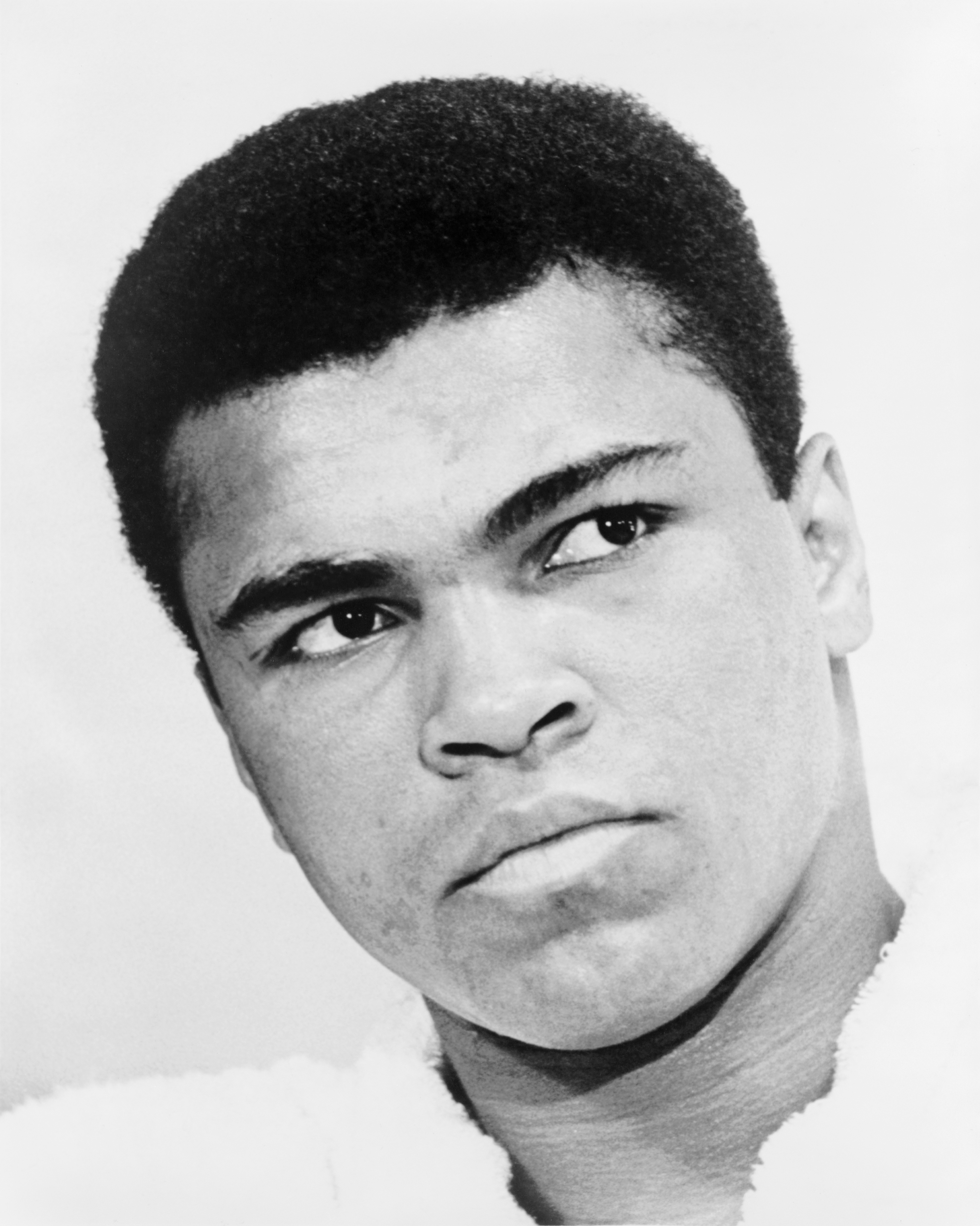
Birth Dates of Notable Kentuckians: January 17, 1942 - Muhammad Ali

 File:Muhammad Ali NYWTS.jpg  Image from Wikimedia Commons

From The Kentucky Encyclopedia -
"Float like a butterfly, sting like a bee, Ali's World Champion for time number three": So said Muhammad Ali, probably the quickest heavyweight boxer who ever fought, at the same time bringing style and showmanship to the ring. Ali held the World Heavyweight Championship during 1964-67, 1974-78, and 1978- 79.

Cassius Marcellus Clay -- as Ali was known before he joined the Nation of Islam in 1964 -- was born on January 17, 1942, in Louisville, to Marcellus and Odessa (Grady) Clay. The Clay family lived at 3302 Grand Avenue in the West End of Louisville. Ali took up boxing at age twelve. His first trainer was Joe Martin at Columbia Gym, who paid Ali four dollars each time one of his fights appeared on a local television program, " Tomorrow's Champions." Ali then switched to trainer Fred Stoner, joining Stoner's camp at the Grace Community Center. He attended Central High School in Louisville, where his studies suffered because of his intense involvement with boxing.

Ali won six Golden Gloves tournaments in Kentucky in weight classes from light to welter to heavy; the total number of his amateur fights is unknown. In 1959 and again in 1960 he won the Light Heavyweight National Golden Gloves and National AAU tournaments. As AAU champion he was invited to the Olympic trials, and became the light heavyweight entry for the United States. He defeated "Ziggy" Pietrzykowski of Poland for the gold medal in 1960.

On October 29, 1960, Ali made his first professional appearance, winning over Tunney Hunsaker by a decision. Needing money to repair his parents' home, he had signed for the fight himself. Ali then contracted to be managed by a group of Louisville millionaires led by William Faversham and remained with them until 1967. His promoters had scheduled training with fighter Archie Moore, but Ali quickly left and hired Angelo Dundee to manage and train him as a professional. Ali worked his way up the ranks, and on February 25, 1964, he scored a seventh-round knockout against Sonny Liston to win the world heavyweight championship.

After a swing through Europe, where he defeated all contenders, Ali received an army induction notice. Although Ali was offered both a commission and a support services assignment, he refused induction for religious reasons. He was sentenced to five years in prison and a $10,000 fine. The World Boxing Association then stripped him of his title on April 28, 1967, and awarded it to "Smokin"' Joe Frazier, the beginning of a bitter feud between the two fighters. Although Ali did not serve jail time, he was barred from boxing, his livelihood.

During his three-year exile from the ring, Ali toured colleges and universities making speeches about civil rights. On June 20, 1970, the U.S. Supreme Court decided in his favor in the army induction case, and Atlanta gave him his first boxing license, which effectively ended the exile. In his first return bout, held amidst protest on October 26, 1970, Ali knocked Jerry Quarry out in three rounds. The feud with Frazier festered, and the first Ali- Frazier bout was scheduled -- Ali's first million-dollar purse and his chance to win back the world heavyweight title. The fight, outstanding in boxing history, was held in New York City on March 8, 1971. Frazier won the fifteen- round decision and retained the championship. Ali suffered his second loss, as well as a broken jaw, at the hands of Ken Norton on March 31, 1973.

Ali met George Foreman, then the champion, on October 30, 1974. This fight, called the "Rumble in the Jungle," took place in Kinshasa, Zaire, and featured a $5 million purse for each man. Ali changed from his famous shuffle, dance, and rope-a-dope style, and stood toe-to-toe with the hard-punching Foreman. The result was a worn-down Foreman whom Ali knocked out in the eighth round to reclaim the championship. The hard-driven Frazier, however, was still there to challenge for the title. Perhaps the greatest heavyweight fight in history was the "Thrilla in Manila" between Ali and Frazier on September 30, 1975. The fight was an action-packed brawl that finally ended when Frazier could not answer the bell for the fifteenth round. Ali lost the title on February 15, 1978, by decision to Leon Spinks, then regained it from him on September 15, 1978, by unanimous decision, becoming world heavyweight champion for the third time. Ali last fought on October 2, 1980, when he was knocked out by Larry Holmes in the eleventh round. The fights took their toll, as Ali developed Parkinson's syndrome.

Ali has been married four times, first to Sonji Rei. He then married Belinda Boyd (Kalilah Tolona) in April 1967; they had three daughters and a son. In June 1977, he married Veronica Porshe; in November 1986, Yolanda Williams. On occasion, Ali returns to Louisville to visit parents and friends. His autobiography, The Greatest (1975), was written with Richard Durham.

JOEL T. SATTERLY, Entry Author

Selected Sources from UK Libraries:

Bingham, H., & Amthor, D. (1993). Muhammed Ali : A thirty year journey. New York: Simon & Schuster.
GV1132.A44 B56 1993, Special Collections Research Center

Hauser, T. (1992). Muhammad Ali : His life and times (1st Touchstone ed.). New York: Simon & Schuster.
GV1132.A44 H38 1991, Special Collections Research Center

Gorn, E. (1995). Muhammad Ali, the people's champ (Sport and society). Urbana: University of Illinois Press.
GV1132.A44 M85 1995, Young Library - 4th Floor

Bingham, H., & Wallace, M. (2000). Muhammad Ali's greatest fight : Cassius Clay vs. the United States of America. New York: M. Evans and.
GV1132.A44 B56 2000, Special Collections Research Center

Other Sources:

Monday, January 11, 2016

Birth Dates of Notable Kentuckians: January 11, 1870 - Alice Hegan Rice

Image from Wikipedia.com


From The Kentucky Encyclopedia -
Alice Caldwell (Hegan) Rice, author, was born in Shelbyville, Kentucky , on January 11, 1870, to Samuel Watson and Sallie P. (Caldwell) Hegan. She attended a private school in Shelbyville and Miss Hampton's College in Louisville, where she began writing. During that time she wrote a parody of Reveries Of A Bachelor by Ik Marvel, which the Louisville Courier-journal published. She and several other women in Louisville organized an authors' club, where they discussed writing and read their works aloud.
At a time when reformers and settlement house workers were calling attention to the living conditions of the urban poor, Hegan began volunteer social work in a truck-farming area south of Oak Street and west of Sixth Street known as the Cabbage Patch. There she taught a boys' Sunday school class at a city mission of the First Christian Church. Inspired by a resident of the desperately poor area, Mary Bass, Hegan transformed her into the fictional Mrs. Wiggs, a widow with five children who lived in dire poverty and had many misfortunes, but who faced life with steadfastness, cheerfulness, and hope. Mrs. Wiggs took in washing and her children -- Jimmy, Billy, Asia, Australia, and Europena -- sold kindling to try to forestall the landlord from foreclosing on the family home.
In 1901 Hegan introduced her novel Mrs. Wiggs Of The Cabbage Patch to the authors' club. She submitted her manuscript to a publisher, and within six months of publication, 10,000 copies a month were being printed -- later 40,000 copies per month. The novel was a best-seller for two years. It was translated into French, Spanish, Norwegian, Danish, German, Japanese, and braille. Mrs. Wiggs was such an international success that Louisvillian Anne Crawford Flexner helped adapt the novel for a stage play presented at Macauley's Theatre in 1903. The Courier-journal proclaimed the play "a distinct success," and it ran for seven years in the United States and for two in England. Mrs. Wiggs also spawned four movies. The first two (1919 and 1926) were silent movies. The 1934 film, featuring W.C. Fields and Zasu Pitts, had its world premiere at the Rialto Theatre on Fourth Street in Louisville. It was proclaimed "the literary event of the season." A fourth film adaptation premiered in December 1942 at the Strand Theater in Louisville, and Louisville actress Fay Bainter won an Oscar for her portrayal of Mrs. Wiggs in this version.
On December 18, 1902, Hegan married Cale Young Rice , a poet, playwright, and philosopher from Louisville. Samuel McClure, publisher of Mcclure's Magazine, bought Cale Rice's first book soon after the wedding and invited the Rices to accompany him on a vacation trip to Europe. Alice Rice's novel Sandy (1905) was a fictional portrayal of McClure and his career. On the trip, she met and formed a friendship with social reformer and muckraker Ida Tarbell.
Alice Rice wrote twenty books, including several sequels to Mrs. Wiggs, most notably Lovey Mary (1903). Her personal favorite was Mr. Opp (1909), in which the title character to all outsiders appeared a failure, yet saw himself as a success in the world, one who refused to recognize defeat. Mrs. Wiggs's observation at the end of the novel expressed this kind of optimism: "Looks like ever'thing in the world comes right, if we jes' wait long enough!" Rice wrote in her autobiography The Inky Way (1940) That She Did Not Want To Record Life's Tragedy. Rather She Wanted Her Autobiography "to Follow, Through A Long life, the course of an inky way that happened to follow a flowery path." Her posthumously published work Happiness Road was described by the New York Herald Tribune as "an exercise in the discipline of happiness."
The Rices built a house in 1910 at 1444 St. James Court, where for thirty years she played the role of gracious hostess. Throughout her life, Rice was involved in philanthropic work. In 1910 Louise Marshall founded the Cabbage Patch Settlement on Sixth Street, a settlement house to reach out to the poor families in the urban neighborhood. Rice was a member of its first board. During World War I, she served as a hospital volunteer at Camp Zachary Taylor . She used that experience as a source for her 1921 novel Quin. Rice supported prohibition and served on the Kentucky State Committee of Law Enforcement.
During the 1920s, Rice collaborated with her husband on two books of short stories. In the 1930s the Rices suffered illness and financial reversals, and her works from that time were written under the burden of financial necessity: Mr. Pete & Co. (1933), a picaresque tale of the Louisville waterfront; Passionate Follies (1936), written with her husband; My Pillow Book (1937), a book of devotions and comments on life. In 1937 she received an honorary doctor of literature degree from the University of Louisville. Rice died on February 10, 1942, and was buried in Cave Hill Cemetery in Louisville.
GAIL HENSON, Entry Author
Selected Sources from UK Libraries:

Rice, Alice Caldwell Hegan. Mrs. Wiggs of the Cabbage Patch. New York: Published by the Century, 1901. Print.
F R36 1st ed., Special Collections Research Center - Fiction Collection

Boewe, Mary. Beyond the Cabbage Patch : The Literary World of Alice Hegan Rice. Louisville: Butler, 2010. Print.
PS3535.I2145 Z6 2010, Young Library - 5th Floor

Rice, Alice Caldwell Hegan. Alice Caldwell Hegan Rice Notebooks. Print.
50M32, Special Collections Research Center - Manuscripts Collection

Tuesday, November 24, 2015

Birth Dates of Notable Kentuckians: November 24, 1877 - Alben William Barkley

   Image from the Library of Congress

From The Kentucky Encyclopedia -

Alben William Barkley, congressman, senator, and vice-president, was born in a log house on November 24, 1877, near Lowes in Graves County , Kentucky. His parents, John Wilson and Electra Eliza (Smith) Barkley, were tenant farmers who raised dark tobacco. Barkley attended common school in Lowes between fall harvest and spring planting. In 1891 the family settled on a wheat farm near Clinton in Hickman County, where Barkley enrolled in Marvin College in 1892. Within five years he earned a bachelor of arts degree.

After Marvin, Barkley enrolled at Emory College of Atlanta, a Methodist school connected with Marvin. He spent the 1897-98 academic year studying classics and participating in the school debating society, but his poverty sent him back to Clinton, where he taught in the Marvin College intermediate department. Unable to afford to rent a room and pay for meals, Barkley resigned in December 1898 and joined his parents in Paducah, where his father had found regular employment. Barkley obtained access to the library of Democratic Rep. Charles K. Wheeler, and in the summer of 1899 barristers William S. Bishop and John K. Hendrick hired Barkley as their law clerk. After two years of study and clerking, he passed the bar examination and opened an office in 1901. Hendrick's friend Judge L.D. Husbands appointed him circuit court reporter.

In Paducah, Barkley joined the Broadway Methodist Episcopal Church and numerous local organizations and attended dances and socials. He was a talented speaker and his rich baritone could be heard preaching lay sermons or telling jokes. He married Dorothy Brower of Tiptonville, Tennessee, on June 23, 1903. They had three children: David Murrell, Marion Frances, and Laura Louis.

In 1904 Barkley entered the Democratic primary for county attorney, establishing in this campaign a successful style and pattern for future runs. He announced his candidacy in December 1904, well before the March primary, because the primary rather than the general election was the key to gaining office in the heavily Democratic region. He was solely responsible for the organization and leadership of the campaign. He overwhelmed the voters with personal appearances, which appealed to his gregarious nature and showed off his talent in speechmaking and debating.

As county attorney, Barkley prosecuted three hundred wrongdoers and saved the county thousands of dollars by challenging overcharges against the local government. In 1907 the Democratic State Central Committee invited him to serve on the speakers' bureau and he was elected president of the State Association of County Attorneys. The local Democratic club looked to save the party from its scandal-ridden image by nominating Barkley for county judge. The 1909 election was the most vicious campaign in Barkley's career, and his victory marked him as a formidable political force.

The new judge repaid his staunchest supporters, farmers, by nearly bankrupting McCracken County with a massive project of road improvements. But he also inaugurated a number of progressive measures, such as appointing a purchasing agent and auditing the county books. Barkley announced late in 1911 that he planned to run for 1st District representative to the U.S. Congress. In the primary, Barkley faced three strong contenders, including his former employer Hendrick.

Barkley quickly took two positions most important to the farmers: lowering taxes and reducing the influence of the railroads through stricter regulation by the Interstate Commerce Commission. He also advocated federal support for highway construction, and his opponents tagged him a socialist. Midway through the 1912 campaign the national Democratic delegates selected Woodrow Wilson as the party's presidential nominee and adopted a progressive platform favorable to Barkley, who with the support of the district farmers won a large plurality in the primary and a secure victory in the general election.

During his seven terms in Congress (March 4, 1913, to March 3, 1927), Barkley served on the Interstate Commerce Commission. Barkley enlisted in Wilson's New Freedom program to bolster economic stability by eliminating financial privilege, and he strongly supported the Clayton Anti-trust Act Of 1914. Barkley moved beyond the New Freedom, however, by seeking governmental solutions to a variety of social problems, including child labor in interstate commerce. He was coauthor of a bill to ban liquor sales in the District of Columbia, which laid the foundation for future prohibition measures; though the initiative eventually failed, it gave Barkley national prominence and put him in the forefront of the Progressive movement. He gave hundreds of talks to aid fellow Democrats in their election bids between 1916 and 1922.

On November 11, 1922, Barkley announced his candidacy in the 1923 Kentucky gubernatorial race. His campaign was spirited, and he earned the nickname "Iron Man." He supported the immediate completion of the state highway network and substantial improvement in the educational system, but he also attacked coal-mining and horse-racing interests. He narrowly lost the primary but gained the future support of Democrats, and when he announced for the U.S. Senate in 1926, no Democrat opposed him.

Barkley defeated Republican incumbent Richard P. Ernst in 1926, and his Senate committee appointments reflected a status far beyond that of a newly elected junior senator. In 1928 he was considered for the vice-presidential nomination; in 1932 he was selected temporary chairman and keynote speaker for the party's national convention. With the onset of the Great Depression, Barkley played a national role as spokesman and policy-shaper during Franklin Roosevelt's terms. Barkley assisted Senate majority leader Joseph T. Robinson in the enactment of much New Deal legislation, defending Roosevelt's policies on national radio. Roosevelt chose him to deliver the keynote address at the 1936 party convention, and when Robinson died in 1937 Roosevelt urged Democratic leaders to make Barkley his successor. The new majority leader was defeated in the management of the president's court-packing plan, but Barkley later impressed his colleagues with his legislative insight and persuasive rhetoric.

Roosevelt's focus on foreign affairs during World War II gave Barkley extraordinary power on domestic programs. Occasionally Barkley disagreed on issues of internal interest, and he slipped uneasily between the roles of administration cheerleader and watchdog. He attacked inequities in the War Production Board's contracting practices and successfully led the passage of a tax bill that Roosevelt vetoed as insufficient. Though Barkley resigned his majority leadership, he was quickly reelected, setting a precedent of autonomy for future congressional leaders. In 1944, however, Roosevelt chose Harry S. Truman over Barkley as his vice-presidential candidate, perhaps in retribution for legislative defeats at Barkley's hands. Though his wife, Dorothy, died of heart disease in 1947, Barkley continued his career and his popularity soared. He received numerous awards, was ranked as the most popular Democrat, and vied with Gen. Dwight D. Eisenhower as Look magazine's most "fascinating" American.

In 1948 Truman asked Barkley to serve again as the convention keynote speaker, and later as his running mate. As the Democrats had seemed ripe for a presidential loss, their victory was a major upset. On January 20, 1949, Barkley took the oath as the nation's thirty-fifth vice-president, the oldest man to do so. He became the only vice-president to wed in office when he married Jane Rucker Hadley on November 18, 1949, after a cross-country courtship. Barkley was the first working vice-president in U.S. history. Because of his legislative expertise, Truman insisted on Barkley's inclusion in all cabinet-level meetings and on the National Security Council. His extraordinary speaking abilities made him the administration's principal spokesman, and Truman commissioned a vice-presidential seal and flag from the army's heraldic branch.

Barkley's age in 1952 prevented his candidacy for president. After leaving office he hosted a national political television show and then retired to write his memoirs. Finding retirement unsatisfactory, he entered the Senate race in 1954, handily defeating incumbent John Sherman Cooper; his colleagues appointed him to the prestigious Senate Foreign Relations Committee. On April 30, 1956, Barkley traveled to Lexington, Virginia , to give a keynote speech before a mock convention conducted by students of Washington and Lee University. There he observed that he "would rather be a servant in the house of the Lord than to sit in the seats of the mighty." At the conclusion of the address, he suffered a fatal heart attack. He was buried in Paducah.

JAMES K. LIBBEY, Entry Author

Selected Sources from UK Libraries:

Barkley, Alben William, and Barkley, Jane R. Alben W. Barkley Papers, 1900-1956. (1900). Print.
63M143, Special Collections Research Center - Manuscripts Collection

Neelley, Ewing Edward. Alben W. Barkley : The Image of the Southern Political Orator. 1987. Print.
E748.B318 N440 1987a, Special Collections Research Center

Reichert, William O. The Political and Social Thought of Alben W. Barkley. Lexington, Ky.: [s.n.], 1950. Print.
Theses 1950, Young Library - Theses 5th Floor Rotunda